
Take the sun’s power into your own hands.
Solar designed around your home and how you use electricity. Produce clean power, buy less from the grid, and see how your system is performing, with a team that stays involved after installation. If solar doesn't make sense for your house, we'll say so.
Licensed general contractor, electricians and roofers · CSLB #948715
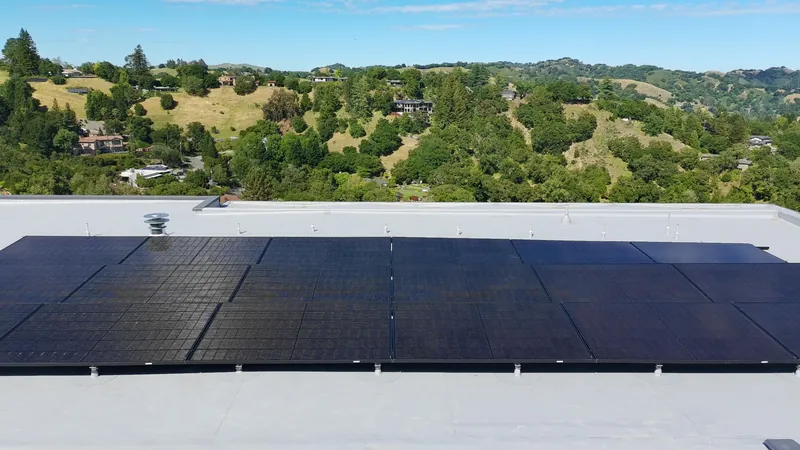
Setting the standard for how solar looks
Your array sits on your house for decades, and your neighbors see it every day. A lot of installs are scattered panels, exposed conduit and gaps around vents. We design every system to look like it was planned with the house, because it was.
That standard takes more time on the layout and the install. It doesn't have to cost you production: we design for both, and show you the trade-off when there is one.
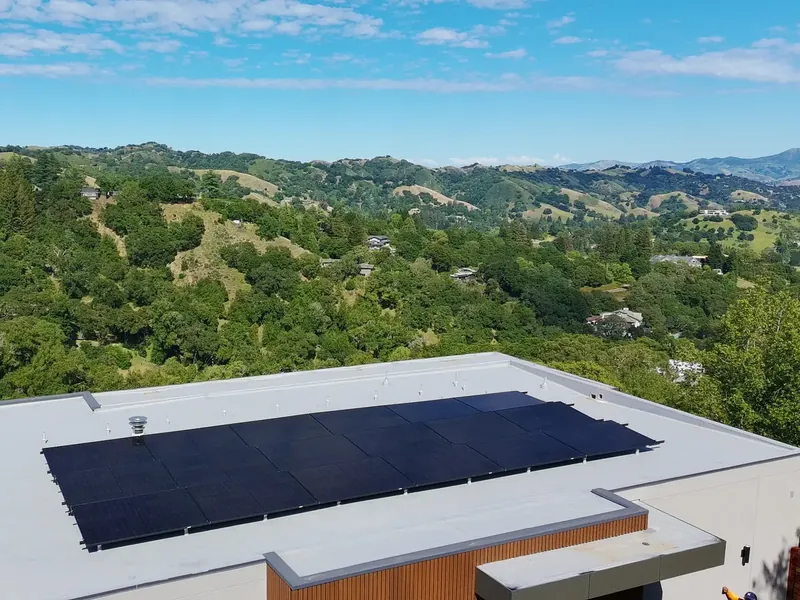
Grouped layouts
As many panels in one place as the roof allows, in clean rectangles, instead of scattered across every plane.
Flush rails, entire array
IronRidge XR-10 rails under every panel, so the edges read as one clean line from the street.
Hidden conduit
Run through the attic or inside walls. Where it has to show, our electricians paint it to match the siding.
No gap-tooth arrays
Roof vents are moved under the array with Solar Roof Jack, so panels don't have to skip around them.
- Conduit across the roof face — gray pipe running over shingles and down the front wall.
- Panels on every plane — a few here, a few there, to hit a number on paper.
- Gaps around vents — missing panels where a pipe or vent was left in place.
- Conduit out of sight — in the attic or inside walls, painted where it has to show.
- One or two clean blocks — laid out on the planes that look best and produce well.
- Vents relocated — moved under the array so the block stays whole.
Have an HOA? We lay out and document the system for design review before we file, so how it looks is settled before it's installed.
From sunlight to your PG&E bill, in five parts
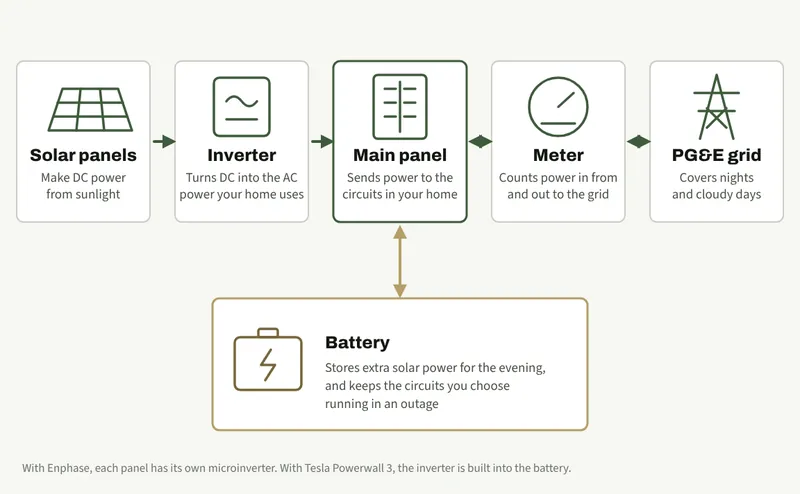
A home solar system is simpler than it sounds. Here is every part, in the order the power moves through your house.
1 · Panels
Turn sunlight into DC electricity. We group them on as few roof planes as the house allows.
2 · Inverter
Converts the panels’ DC power to AC for your house: an Enphase microinverter under each panel, or a Tesla Powerwall 3 with the solar inverter built in.
3 · Your electrical panel
Solar feeds the main panel and your house uses it first. We check the panel’s capacity before we design anything.
4 · The PG&E meter
What you don’t use goes to the grid for a credit on your bill. At night, you draw from the grid as usual.
5 · Monitoring
Each panel reports its production. You see it in the app, and so do we.
“Will my panels keep the lights on in an outage?”
It’s a fair question, and the answer surprises most homeowners. A solar system on its own shuts off when the grid goes down, so it can’t send power onto lines a utility crew is repairing. To keep running in an outage, the system needs a battery that can separate your house from the grid.
That’s why we talk about storage in the first conversation, even if you add it later. See batteries and EV chargers.
Follow it as closely as you like
You don’t have to study an app to benefit from solar. Some homeowners check every sunny day; others look once a month. Both work.
If you like to watch
The Enphase or Tesla app shows what your system is producing and, with the right metering, what your house is using. Seeing when you use the most power helps you decide when to run the dishwasher or charge the car.
If you’d rather not
We watch the monitoring portal too, and reach out when a system goes quiet or something looks off. You’ll still get a clear answer whenever you ask how it’s doing.
From your usage to a system we keep watching
Your usage, reviewed
We go through your PG&E usage, ask what you want solar to do for you, and check the roof and electrical panel the system depends on.
Design, checked before it’s filed
The roofing and electrical crews review the plan set before it goes to the city, so questions get answered on paper instead of on your roof.
Permits and PG&E
We pull the permit and file your interconnection application. In Danville and Contra Costa County, contract to install can take as little as 2 weeks.
A clean install
Licensed roofers handle the mounts and flashing. Licensed electricians handle the wiring. Each owns their part of the job.
Final inspection, then payment
Most homeowners pay once, after the city signs off. No string of progress payments to track.
We keep watching
We watch the Enphase, SolarEdge and SMA monitoring portals, and often spot a fault before you do.
You don’t chase subs; we do
Licensed roofing and electrical crews each own their scope, and we coordinate all of it. You have one company to call.
You’re on the project thread
Each job gets a WhatsApp thread with you, the project manager, design and the install crews, so updates and PG&E details reach you directly.
If the roof is due, you’ll hear it first
Panels stay up for decades. If your roof won’t last that long, replacing it first saves paying to take the array off later. Our sister company, Affordable Roofing Systems, does the roof on the same schedule.
Two platforms, matched to your house
We install both, so we can recommend the one that fits your roof, your usage and what you want backed up.
Panel-level control and visibility
Each panel gets its own IQ8 microinverter, so conversion happens across the roof instead of in one box, and you can see what every panel is producing.
- Distributed conversion — a problem with one microinverter is usually limited to its own panel.
- Panel-level monitoring — helps pinpoint where an issue is before anyone climbs the roof.
- Modular storage — IQ Battery 5P (5.0 kWh usable) and IQ Battery 10C (10.0 kWh usable), sized in steps to your needs.
Your roof has several planes or spots of shade, or you want to see each panel and add storage in smaller steps.
Solar conversion and storage in one system
Powerwall 3 combines the battery and the solar inverter. Panels connect directly to it, and one app runs solar, storage and backup.
- 13.5 kWh per unit — with up to 11.5 kW continuous output, enough to run more of the house at once.
- Expansion units — each adds 13.5 kWh of storage without another inverter.
- Inverter replacements — a failed string inverter can sometimes be replaced by a Powerwall 3, after we check the existing array.
You want substantial backup power from one main unit, or your current string inverter has failed and you’re weighing an upgrade.
Your proposal compares complete designs on the same terms: production, storage, backup power, which circuits stay on, and total installed price. Specifications here are the manufacturers’ published figures; your design decides what applies.
IronRidge XR-10
Flush rails under the entire array, mounted and flashed by licensed roofers, on either platform.
No mixing brands
Add-ons and replacements match the platform you have, so one manufacturer can’t point at another when something needs service.
New roof under your panels? We take them off and put them back
When the roof under an array needs replacing or repair, the panels have to come off first. Because our sister company, Affordable Roofing Systems, does the roof, it all runs on one schedule and one proposal.
Document and shut down
We photograph the array, the wiring runs and every mount before anything is touched, and shut the system down safely.
Remove and store on site
Panels and racking come off before tear-off and are stored on your property, not hauled away.
New roof, new flashing at every mount
The new roof goes on, and every mount point gets new flashing as part of the roof, not patched in afterward.
Reinstall and turn back on
The array goes back up on flush rails, the system is tested, and we confirm it is reporting before we leave.
- Its own line in the proposal — removal and reinstall is priced separately from the roof, so you see the whole cost before you sign.
- One company owns the leak — the roofer and the solar crew answer to the same ownership, so a mount that leaks has one owner.
- Systems we didn't install — Enphase, Tesla, SolarEdge and SMA systems can all come off and go back up.
- A chance to clean it up — if conduit runs across the roof today, we can talk about rerouting it while the array is off.
Let the sun pick up some of the bill
What solar saves depends on how much it produces, how much of that you use at home, your rate plan, and whether a battery stores the rest. Every number in your proposal is an estimate, shown in this order.
- 01First-year bill savings — what your PG&E bill could look like in year one, built from your own usage.
- 0225-year lifetime savings — the same estimate carried across the life of the system.
- 0325-year net gain — lifetime savings after the cost of the system, cash or financed, side by side.
Already have solar? We can still help
Most installers disappear after the system turns on. A lot of our work is with homeowners whose systems are years old, including ones we didn’t install.
Monitoring
We watch Enphase, SolarEdge and SMA portals and call you when a system goes quiet or a part fails.
Enphase upgrades
Systems with older Enphase microinverters often have an upgrade path, and most homeowners don’t know it exists. We recently upgraded a 55-panel system.
Panel cleaning
Done by a solar professional who knows how to clean panels without damaging them, for better production.
Inspections for home buyers
Buying or selling a house with solar? We confirm the system was installed properly and is working, for you or your agent.
Inverter failed?
It’s a good time to compare restoring the system as it is with upgrading to battery-backed solar. We review your equipment and quote both.
Service and repairs
Our electricians work on Enphase, Tesla, SolarEdge and SMA, so a failed part gets diagnosed and replaced with a matching one.
Ground mounts
When a hillside or yard makes more sense than the roof, we’ll say so and design for it.
What homeowners say, word for word
“The whole team, from the CEO to the licensed contractors used for installation, are friendly, informative, and ALL easily accessible.”
“Almost 5 years in … the team continues to be available to us for calls, questions, and inquiries with prompt replies.”
“Bob was the only representative to actually go on the roof to determine the best placement of the arrays.”
Solar questions homeowners ask us
Find out if solar makes sense for your house.
Send us a recent PG&E bill. We’ll review your usage and suggest a system, or tell you straight if it doesn’t add up yet.